

TRADE ON THE MODERN SILK ROAD
The historical Silk Road, the world’s oldest trade route, connects Asian and European countries, while also offering new commercial connections and advantages for the countries on the route. The Belt and Road Initiative aims to revive the historical Silk Road trade.
Nearly two thousand cooperation projects were carried out within the framework of the Belt and Road Initiative. The total trade between China and other Belt and Road countries has exceeded $7.8 trillion by the end of 2020.
While promoting multilateral economic and commercial cooperation, for companies the modern Silk Road has become a gateway to the vast and diverse Chinese market. Moreover, the Belt and Road facilitated regional trade, eased capital flows and deepened cooperation with other countries.
As Dakik Trade; we are actively involved in the trade between the modern Silk Road countries; by combining our commodity expertise with our railway experience, which is dominant in the region.

FROM THE HISTORICAL TO THE MODERN SILK ROAD: ONE BELT ONE ROAD INITIATIVE
While the trade of the most valuable goods of agricultural societies was carried over the historical silk road, having a silk road became a strategic value. The search for an alternative route to the silk road gave birth to geographical discoveries and new sea routes gave Western Europe a dominant economic power.
The industrial revolution grew out of the use of mechanical power in transportation. The growth of markets, huge production and the transportation of raw materials needed, has been made possible by railroads and steam trains.
While every new road helps the economic potential to grow, “the Modern Silk Road,” nowadays, opens up a much bigger road, and while this road is built by 65 countries on the traces of history, Turkey joins to the most important actors of the project with “the Middle Corridor.”
This giant project, a joint investment of 65 countries; strengthens the relations between countries, therefore it will be able to provide a stable trade between East-West civilizations and even change the center of gravity of world trade.
THE MODERN SILK ROAD; ARISE OF ONE BELT ONE ROAD IDEA
Modern Silk Road Project was initially brought by President of China; Mr. Xi Jinping during his visit to Kazakhstan. The Chinese Government decided the construction of Silk Road Economic Zone and the Silk Road Sea lanes. After then, they decided to rename two projects under one name as “One Belt One Road”.
In the project, the term “belt” represents to roads, railroads, oil and natural gas pipelines as well as other investments on infrastructure. It refers to the transportation network starting from China and reaching Central Asia, Moscow, and Venice. The term “road” refers to the sea lanes. Belt and route planning connects East Asia to European economy by corridors that enter the continents of Asia, Europe, and Africa.
SCOPE OF THE PROJECT
One Belt One Road Project covers Europe, Eurasia, Asia-Pacific regions and most of the countries included are developing countries or economies. One Belt One Road affects 4.4 billion people which corresponds to 63% of the world’s population. And this population; with an economic revenue of 21,000 billion dollars; is in the 21% share of the world income
Since the countries within the scope of the project are complementary to each other in important fields such as transportation, finance, energy, telecommunications, agriculture and tourism, they have a global potential market size for the mutual cooperation of national economies.
On the east side, the vibrant Asia-Pacific economic circle and on the west side, the developed European economic circle; it is the world’s longest economic corridor with the highest development potential.
SCOPE OF THE MIDDLE CORRIDOR AND TURKEY’S IMPORTANCE
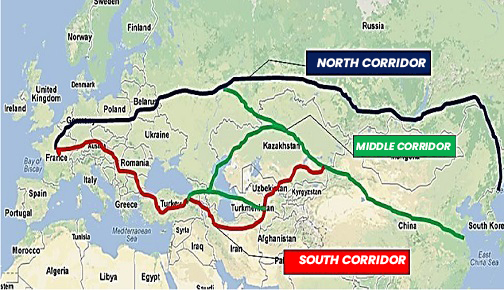
One Belt One Road, Middle Corridor Project plans to create a corridor starting from Turkey reaching to Georgia and Azerbaijan via the railway, and then over the Caspian Sea to Turkmenistan and Kazakhstan via the ferry, and from Urumqi to the city of Xi’an. The Middle Corridor of the One Belt One Road project created by Turkey will enable a train departing from China to reach London.
Within the scope of the Modern Silk Road Project; Turkey becomes a key country due to its strategic location at the intersection of Asia, Europe and Central Asia. With this project, China aims to connect the Northern Corridor through Russia, the Southern Corridor through Iran; and with the Middle Corridor, it aims to connect Europe and Turkey, Central Asian countries, Turkic Republics, Afghanistan and Pakistan to China.
The Middle Corridor increases the importance of the project by creating an alternative to the North and South Corridor. For the Middle Corridor, a budget of 8 trillion dollars is foreseen and China plans to spend 40 billion dollars of this budget on transportation networks. The European-Caucasian-Asian Transport Corridor (TRACECA), which is a component of the Middle Corridor, has been connected to Kars and Edirne with the high-speed train project under Baku-Tbilisi-Kars railway. The TRACECA project, which will form an important part of the project that uninterruptedly connects London and Beijing, will be integrated with Marmaray and Yavuz Sultan Selim Bridge.
Within the scope of the Middle Corridor project, Turkey’s geographical location, its historical and cultural ties with European, Middle Eastern, Central Asian and African countries contributed to Turkey being seen as an important and strategic country by China. And for Turkey, the revival of the Silk Road will help increase cooperation with China and reduce the imbalance in bilateral trade relations. In addition, attracting tourists and investments, technological cooperation and improving the relations with Central Asian Turkic countries will be important for Turkey to increase its share in Asian market.
Corridors Connecting East and West
in the Modern Silk Road Project
THE ECONOMIC BENEFITS OF THE MODERN SILK ROAD PROJECT TO TURKEY
Turkey, being the most important route country of the Silk Road in the past, constitutes the Asia-Europe connection point of the roads and railways included in the project due to its geopolitical position. With the completion of the Belt and Road project, Turkey aims to significantly increase its trade volume with the Asian market.
Once the project is fully operated; the fact that the delivery time of the products sent by sea from Beijing to Istanbul, will decrease from two months to two weeks, is a factor that reveals the necessity of Turkey’s involvement in the project.
One of the important aspects of the Silk Road project for Turkey is the win-win approach. With this project, Turkey and China have established strategic cooperation in various fields. Belt and Road Project strengthens Turkey’s Eurasian bridge role with its increased transaction volume on the railroads from Asia to Europe.
The Modern Silk Road project is expected to stimulate foreign capital and investment inflows in Turkey and to improve the trade volume with China. Therefore, it is likely that economic relations with the Central Asian Countries located on the route will increase.